|
Jerry Kennedy was born Gerald Glenn Kennedy on 10 July 1939 in Shreveport, Louisiana, and grew up in a musical environment that shaped his early interest both in the guitar and in songwriting.
He developed his skills as a guitarist during his youth - his parents having bought him a guitar for his 8th birthday. He was tutored by Shreveport guitarist Tillman Franks who would go on to manage the country stars David Houston, Webb Pierce, Claude King and Johnny Horton and to co-write such hits as "When It's Springtime in Alaska (It's Forty Below)", "Honky Tonk Man" (later recorded by Dwight Yoakam), and the massive crossover hits "Sink the Bismark" and "North to Alaska".
Jerry himself began performing in Shreveport at the age of ten (he was actually signed to a solo recording contract by RCA as an eleven-year old!) and entered the professional music industry in the late 1950s, when he began working in studios and touring bands in the American South. backing such stars as Johnny Horton and Faron Young.
His technical fluency, stylistic adaptability, and calm professionalism quickly made him a valued accompanist, and he soon relocated to Nashville, where he became part of the city’s expanding recording infrastructure. Here he worked with Elvis Presley ("Good Luck Charm"), Rex Allen ("Don’t Go Near the Indians"), "King of the Road" (Roger Miller), and many more hits.
By the late 1960s, Jerry Kennedy had firmly established himself as one of Nashville’s most dependable session guitarists, contributing to recordings by a wide range of country and pop artists, including Kris Kristofferson, Johnny Cash, Ringo Starr, Stonewall Jackson and George Jones. At the same time, he built a parallel career as a record producer, initially through work with Mercury Records and its country subsidiary Smash.
Although he rarely if ever got a co-writer's credit for his very significant contributions to the songs he helped record, it was he who created the legendary riffs that dominated such hits as "Oh Pretty Woman" (Roy Orbison), "Stand By Your Man" (Tammy Wynette) and Jeannie C. Riley’s "Harper Valley PTA". And of course, he contributed so much also to Bob Dylan's seminal 1966 album "Blonde On Blonde".
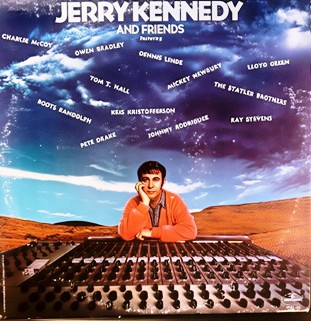
Jerry produced numerous hit recordings, most notably for Tom T. Hall, whose conversational songwriting style suited Kennedy’s understated, song-centred production approach. It was Jerry Kennedy who oversaw Jerry Lee Lewis's move from Rock & Roll to country, while also working with such stars as Dave Dudley, Faron Young, Bobby Bare, Charlie Rich, Brook Benton, Leroy Van Dyke, Ray Stevens, Connie Smith, Mel McDaniel, and Mickey Newbury.
Jerry’s reputation rested on his ability to foreground lyrics and melody, avoid excessive ornamentation, and create records that sounded contemporary without abandoning country traditions. He was also a shrewd judge of talent, signing and helping to develop such rising stars as Reba McEntire and Johnny Rodriguez.
Alongside his production work, Jerry also wrote and co-wrote songs throughout his career, often collaborating with other Nashville songwriters. While never a prolific composer, his songwriting reflected the same craftsmanship and restraint that had always characterised his studio work.
In the late 1980s and early 1990s, he extended his role through his work with Garth Brooks, helping to align Brooks’s blend of traditional country narrative with his arena-scale emotional reach. This collaboration demonstrated Jerry’s capacity to adapt to the new generation of country artists while maintaining structural clarity and lyrical directness and this work with Brooks contributed to the broader sound and thematic confidence of an artist who redefined commercial country music during that period.
Jerry Kennedy continued to work steadily as a producer, guitarist, and mentor figure in Nashville well into later life, remaining respected for his good taste, musical judgement, and deep understanding of the recording process, leaving behind a body of work that spanned more than six decades of recorded music.
Jerry would also create an influential dynasty.
One of his sons - Gordon Kennedy - would go on to become a member of the CCM band WhiteHeart, co-writing Eric Clapton’s "Change the World" - winner of the 1996 Song of the Year Grammy Award - as well as hits for Trisha Yearwood, Bonnie Raitt, Peter Frampton, Garth Brooks, Faith Hill, Carrie Underwood, Tim McGraw, Wynonna, George Strait and Charlie Daniels.
Another son Shelby would work for ASCAP, help launch Alan Jackson's career, while penning songs for (amongst others) Ray Charles as well as the theme for the TV series "Reba", while a third son, Bryan, would of course co-write such Garth Brooks' favourites as "American Honky Tonk Bar Association", "Beaches of Cheyenne" and "Good Ride Cowboy."
As a talent, Jerry Kennedy excelled less through flamboyance than through precision, boundless taste, and an empathy for the song. His guitar playing was economical and expressive, his productions disciplined and uncluttered, and his songwriting rooted in function rather than self-display. His legacy in the history of popular music lay in his role as an enabler of others’ voices: a craftsman whose quiet authority helped shape classic country recordings and supported the evolution of Nashville from a regional industry into an international centre of popular music.
Jerry Kennedy died on the 11th of February 2026 in Nashville, Tennessee, USA, at the age of 86, from undisclosed causes.
© Jim Liddane
Copyright Songwriter Magazine, International Songwriters Association & Jim Liddane: All Rights Reserved
This is just one of the many profiles of leading songwriters, singers, musicians and music industry personnel, published by the International Songwriters Association and "Songwriter Magazine". Please click HERE for a full list.
The Main Menu

ISA • International Songwriters Association (1967)
internationalsongwriters@gmail.com
The Small Print
This International Songwriters Association 1967 site is a non-profit non-commercial re-creation of portions of the full site originally published by the International Songwriters Association Limited, and will introduce you to the world of songwriting. It will explain music business terms and help you understand the business concepts that you should be familiar with, thus enabling you to ask more pertinent questions when you meet with your accountant/CPA or solicitor/lawyer.
However, although this website includes general information about legal issues and legal developments as well as accounting issues and accounting developments, it is not meant to be a replacement for professional advice. Such materials are for informational purposes only and may not reflect the most current legal/accounting developments.
Every effort has been made to make this site as complete and as accurate as possible, but no warranty or fitness is implied. The information provided is on an "as is" basis and the author(s) and the publisher shall have neither liability nor responsibility to any person or entity with respect to any loss or damages arising from the information contained on this site. No steps should be taken without first seeking competent legal and/or accounting advice
Some pictures on this site are library images supplied by (amongst others) the ISA International Songwriters Association (1967), International Songwriters Association Limited, Dreamstime Library Inc, BMI (Broadcast Music Inc), ASCAP (American Society Of Songwriters, Authors and Publishers), PRS (Performing Rights Society), PPS (Professional Photographic Services), RTE (Radio Telefis Eireann) TV3, and various Public Relations organisations. Other pictures have been supplied by the songwriters, performers, or music business executives interviewed or mentioned throughout this website, while certain pictures are commercial stock footage of businesses and office environments generally, rather than specific images of the ISA, its personnel, facilities or members.
In any event, all images are and remain the property of the individual owners unless indicated to the contrary.
Home •
Interviews •
Writing A Song
|